St James Guide
The article on my work that appeared in the St James Guide to Horror, Ghost and Gothic Writers:


posted by Postmodern Mariner @ 11:25 AM
0 comments

More ramblings of Rhys Hughes.
The article on my work that appeared in the St James Guide to Horror, Ghost and Gothic Writers:
posted by Postmodern Mariner @ 11:25 AM
0 comments
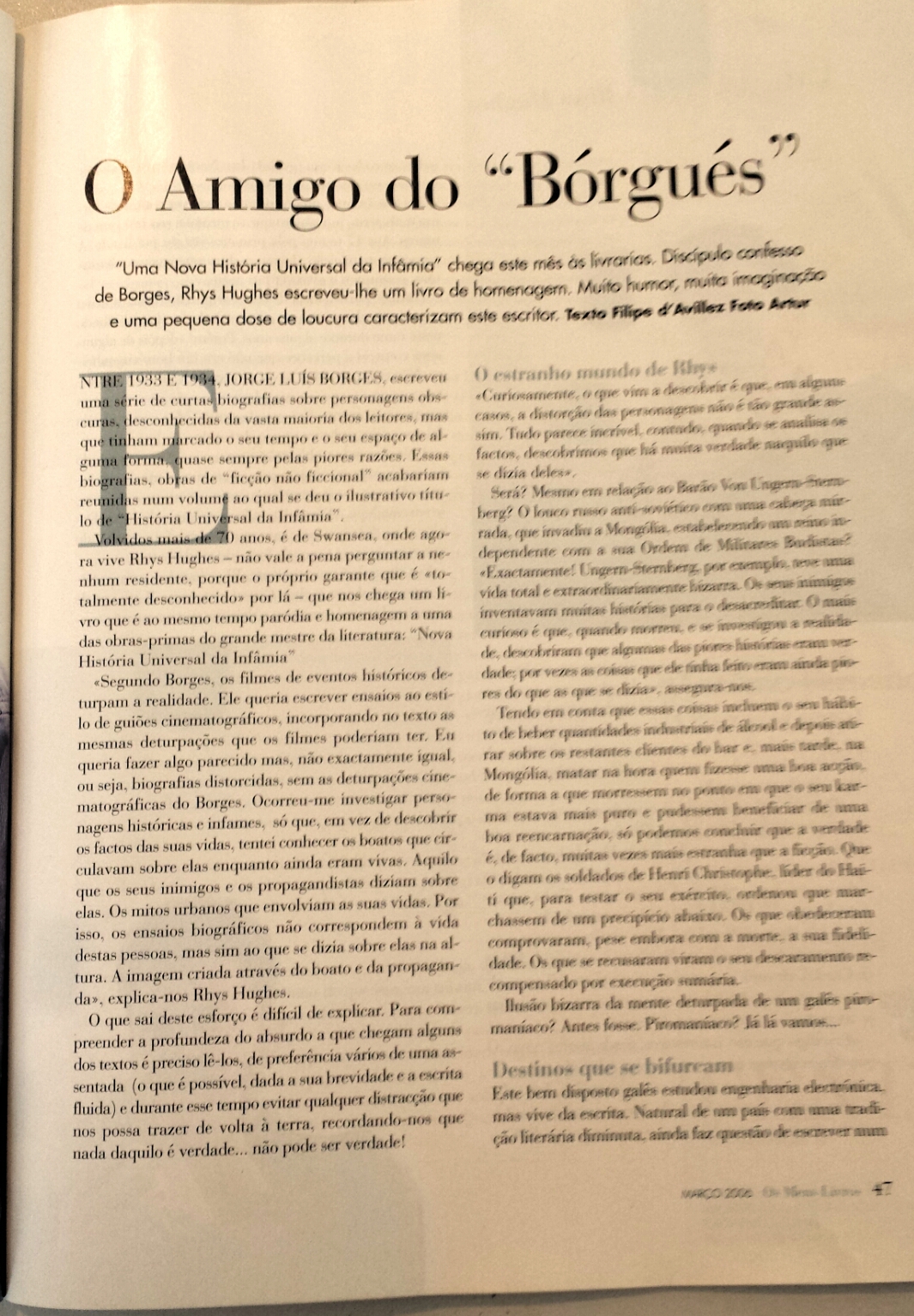
The article on my work that appeared in Os Meus Livros on 4th March 2006.




posted by Postmodern Mariner @ 11:23 AM
0 comments

 How is it possible for a human being to cry such an amount of liquid? A human being is approximately 60% water, so that a man weighing 70 kilograms will contain about 40 litres, or twenty seven thousand times less than the amount drained by our hypothetical river every second. In order to cry a river, a human eye would have to be scaled up until it was 685 metres in diameter!
posted by Postmodern Mariner @ 4:25 AM
0 comments
Years ago I read somewhere that people only started smiling for the camera after film replaced photographic plates. The first practical film was developed by George Eastman in 1884. In early photography, sitters were required to pose for a long time in front of the camera and it was difficult to hold a smile for such a lengthy period: hence 'solemn' expressions were normal.


posted by Postmodern Mariner @ 4:09 AM
0 comments
I have just put together a collection of 'tribute' stories to a handful of authors I admire. I have written many such stories over the years; I have gathered together 20 of them into one volume that will be called The Senile Pagodas.
posted by Postmodern Mariner @ 3:50 AM
1 comments
My new novel, The Abnormalities of Stringent Strange, is now available to pre-order! Here is a 'buy now' button if you want to pre-order it; and if you do you'll get a mention in the book itself as one of the audience members in the extended gladiatorial battle scenes!
posted by Postmodern Mariner @ 3:05 AM
0 comments
This morning I finished writing my 666th story. To celebrate this occasion I decided to dress in a manner similar to that of the great Aleister Crowley, who was intimately associated with this magickal number.

posted by Postmodern Mariner @ 4:15 AM
0 comments

posted by Postmodern Mariner @ 3:20 AM
0 comments

posted by Postmodern Mariner @ 2:38 AM
0 comments

posted by Postmodern Mariner @ 6:58 AM
0 comments
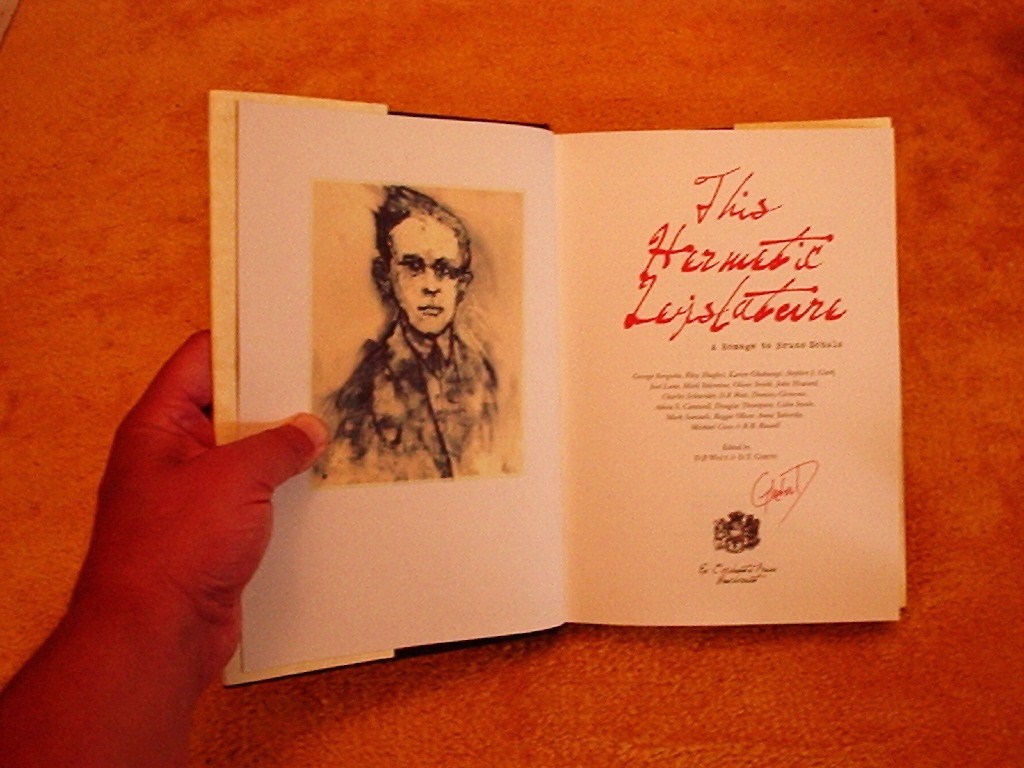
Dan Ghetu of Ex Occidente Press in Romania has excelled himself this time with a tribute volume to the magnificent Bruno Schulz. Of the three major tribute anthologies that Ex Occidente have released in the past few years, this one is the most aesthetically delightful.

posted by Postmodern Mariner @ 6:11 AM
1 comments
posted by Postmodern Mariner @ 3:20 AM
2 comments
Dadaoism is the new anthology (the first anthology if we're going to be picky; and why shouldn't we be?) from the soon-to-be-legendary Chômu Press. I took my bicycle to the depot to pick up my copies, for yes, as it happens, I have a story in this book, and it is customary for contributing authors to receive free complimentary copies of the anthologies they appear in. This anthology was very complimentary. All the way home it mumbled, "Nice cycling technique!" from the depths of my rucksack, where I had stored it in order to facilitate its conveyance home. Old joke!

posted by Postmodern Mariner @ 2:32 AM
2 comments
People often ask me, "What do your publishers look like?"

posted by Postmodern Mariner @ 3:10 AM
0 comments
Here's a new microfiction for you. It's only 169 words long. I enjoy writing microfictions, flash fiction and mini-sagas and I've produced a lot of them over the past twenty years. A selection of 101 are featured in my ebook Flash in the Pantheon, available from Smashwords for $2.99. Anyway...
posted by Postmodern Mariner @ 3:21 AM
0 comments
 I've just noticed that the brilliant writer Rudy Rucker has released an ebook of his complete short stories. It's available from Amazon here. Rucker is one of the best and cleverest living writers. In fact he's one of the best and cleverest writers in the history of humanity. He's an authentic genius, a genuine ideas writer (quite a rare thing these days) with a comprehensive and profound understanding of mathematics, metaphysics, futurology, artificial intelligence and the paradoxes of space, time and geometry.
posted by Postmodern Mariner @ 3:17 AM
0 comments
The book of Rhysop's Fables is ready at last!

posted by Postmodern Mariner @ 2:55 AM
0 comments
I have been writing fables recently, lots and lots of them. In fact I've just completed 150 of the blighters and soon I'll put them all in a collection of their own. One of these fables was inspired by a game of pun-tennis that I played with Bob Lock a few weeks ago. It's right to give him credit for the original inspiration of what follows. In fact, he planted the "Uzbekistan" seed from which the rest developed...
posted by Postmodern Mariner @ 2:24 AM
2 comments
My minor story-cycle of extreme exploratory daftness is now complete. Six tales featuring the two most inept and inelegant members of the Eldritch Explorers' Club... Thrill with Hogwash and Bum Note as they venture into the jungles of Yuckystan, tangle with Tarka the Rotter, flee from giant ducks, meet the monkey with too many cheeks, attempt to pluck notefruit from the Melody Tree, and finally go in search of the Infamous Anteater in order to get his autograph!

posted by Postmodern Mariner @ 2:14 AM
0 comments
Recently I filled in an online questionnaire about suggested improvements to the awards procedure of the BFS (British Fantasy Society). Why I was asked to do this is a mystery, as I'm not a BFS member or a member of any society. I'm a contrarian-libertarian-individualist, but we'll let that pass for the moment. Maybe the questionnaire was sent to me because of a simple clerical error? I filled it in anyway.
posted by Postmodern Mariner @ 3:23 AM
1 comments
More ramblings of Rhys Hughes.

I am a fictional character created by the author Rhys Hughes in order to promote a book called THE POSTMODERN MARINER.

